Showing posts with label trading forex. Show all posts

Tuesday, August 25, 2009

McCann Sues Bank of America Seeking to Void Non-Compete Clause

Former Merrill Lynch & Co. brokerage head Robert McCann sued Bank of America Corp. to force the company to release him from exit terms that keep him from taking another job.

Bank of America fired him without cause after rejecting his resignation, making the Charlotte, North Carolina-based company unable to enforce a non-compete clause, McCann said in a suit filed yesterday in New York State Supreme Court.

McCann, 51, announced plans to leave Bank of America in January, less than a week after the company completed its $18.5 billion acquisition of Merrill Lynch. He said in the suit that he left for “good reason” after his role was “severely diminished” and he didn’t get a bonus following the sale. After initially saying McCann’s resignation would be effective in July, the bank fired him in February, according to the suit.

UBS AG, Switzerland’s largest bank, was close to hiring McCann as head of its wealth management unit in the Americas, the Financial Times said this month. The newspaper also reported McCann’s suit yesterday.

Bank of America spokesman Scott Silvestri declined to comment on the suit. UBS spokesman Mark Arena didn’t return a call for comment.

McCann said in his lawsuit that Bank of America was required to buy his Merrill Lynch shares for more than $18 million after firing him and hasn’t done so.

He was named in 2003 to head the brokerage unit that Bank of America Chief Executive Officer Ken Lewis last year called Merrill Lynch’s “crown jewel.” Dan Sontag replaced McCann in January, and Sallie Krawcheck, who previously led Citigroup Inc.’s Smith Barney brokerage, took over for Sontag this month.

link....

Read more...

Monday, August 24, 2009

European Opposition Mounts Against Google’s Selling Digitized Books

The Bodleian Library at Oxford University, above, is working with Google to digitize its books.

BERLIN — Opposition is mounting in Europe to a proposed class-action settlement giving Google the right to commercialize digital copies of millions of books.

The settlement would permit Americans to buy online access to millions of books by European authors whose works were scanned by Google at American libraries.

While some big European publishers, like the Oxford University Press and Bertelsmann (which owns Random House) and Georg von Holtzbrinck (the owner of Macmillan), support the agreement, there is widespread opposition among French publishers. The German government, supported by national collection societies in Germany, Austria, Switzerland and Spain, plans to argue against it and encourage writers to pull out of the agreement.

A United States District Court has set a Sept. 4 deadline for submissions on the settlement and plans to hold a hearing Oct. 7.

Akash Sachdeva, an intellectual property lawyer with the law firm Allen & Overy in London, said that last-minute objections from Europe were unlikely to stop the settlement from going forward.

“I would imagine the court is going to say that because you have a significant amount of big players around the world who have opted into this, then it is worth proceeding with,” he said.

Google, which has been digitizing books since 2004 to make them available online, says the proposed settlement will benefit publishers, authors and consumers, making a vast reservoir of work available for easy access.

Around the world, 25,000 publishers, libraries and individuals are working with Google to digitize their archives and catalogues, including Oxford’s prestigious Bodleian Library and the Bavarian State Library. Even the French National Library, an outspoken opponent of the project, said last week that it was talking to Google about a deal to help digitize its archives.

“We believe that we are helping the industry tremendously by creating a way for authors and publishers to be found,” said Santiago de la Mora, Google’s head of printing partnerships in London. “Search is critical. If you are not found, the rest cannot follow.” link....

Read more...

Saturday, August 22, 2009

Bank of America Adds a Director

Bank of America, which has lost 10 directors through resignations or retirement since April, elected a former Morgan Stanley executive, Robert Scully, to its board, which now has 14 members. Mr. Sully, 59, part of Morgan Stanley’s office of the chairman until he retired in January, oversaw asset management, merchant banking and the Discover credit card business, the bank said. link.....

Read more...

West Will Languish; Asia Will Lead

AFTER THE RECENT JUDDER IN THE ASIAN MARKETS, WHO BETTER to ask about the region's prospects than Christopher Wood? The Hong Kong-based strategist for CLSA Asia-Pacific Markets, a unit of Crédit Agricole, pens the widely followed newsletter Greed & Fear.

He was early to spot the problems in the U.S. mortgage market and their global financial implications, writing about them back in 2005.

Even earlier, he espied the troubles brewing in Thailand, before the 1997 Asian crisis.

[qa]
Darrin Vanselow for Barron's
"When I say you want to be overweight Asia and emerging markets, I'm talking predominantly about investing in domestic themes such as financial services, real estate and infrastructure." --Christopher Wood

Midway through last week, the MSCI AC Asia ex-Japan index had risen by 79% in U.S. dollar terms since the October 27 bottom, while the Standard & Poor's 500 is up just 17% over the same period. Wood acknowledges a modest correction may be in order, but believes prospects are good for a long-term bull market in Asia. To learn why, keep reading.

Barron's: You sure got this crisis right. Where are we now?

Wood: This financial crisis in the Western world will lead to a long period of anemic growth. The data that is making people more optimistic on the U.S. right now is tending to be production-oriented data like the ISM [a survey of manufacturers] or car sales. But there is very little sign to me that U.S. consumer demand is recovering or that real releveraging is taking place.

In fact, all the evidence both in the U.S. and Euroland is that the consumer is going into long-term retrenchment. Even when the banks in America and Europe become healthier in coming quarters and years, I believe demand for credit will be much less than it was in the last five, ten years. So, we are going into a long-term period of deleveraging. We'll continue to see deflation backdrops in the Western world. The best case is a long period of subpar, anemic growth. link.....

Read more...

Stocks Still Follow Crude, But For How Long?

As crude oil on Friday hit a high for the year above $74 a barrel, energy shares rallied, fueling the broader U.S. stock market toward weekly gains. But if oil's price gains continue, what has been viewed as a bullish signal could easily turn bearish for U.S. equity investors.

Positive U.S. and European economic data, along with weakness in the dollar, helped in supporting oil's surge, with the front-month futures contract lately up $1.13 at $74.04 a barrel, after earlier hitting $74.72 -- its highest level so far this year. .

Crude futures have had "trouble staying above $73" and hence had been trading in a range of $65 to $73 a barrel, said Kevin Kruszenski, director of equity trading, KeyBanc Capital Markets Inc.

"So today it's a focus, since we're at a very important level," he said.

While crude's climb on Friday had it rallying to its highest point yet for the year, a barrel of oil remains roughly half of where it stood at its height last summer, when crude-oil futures on July 11 hit an intraday high of $146.65, with the Dow industrials shed 129 points that day.

"A year or so ago, higher (oil) prices were bad for the stock market, now the inverse is true. It's seen as a sign of economic recovery," Kruszenski noted.

Rising energy costs would be seen in a less favorable light should the price of crude climb back over $100 a barrel, Kruszenski said. That said, it's unlikely that that would happen anytime soon, he added.

"It's too early in the economic recovery. I don't think there is enough business or consumer activity," said Kruszenski.

Other analysts had differing views on the tipping point at which rising crude prices would fall out of favor with equities investors.

In the view of Mike Zarembski, senior commodities analyst at OptionsXpress, crude at $80 to $85 a barrel would take the steam out of an economic rally.

On Wall Street, energy shares fronted the broad market's advance to close out the week, with shares including Nabors Industries Ltd. (NBR) and Cameron International Corp. (CAM) both up nearly 5%.

The Dow Jones Industrial Average (DJI) added 146.31 points, or 1.5%, to 9, 496.36, while the S&P 500 Index (SPX) climbed 16.86 points, or 1.7%, to 1, 024.23. The Nasdaq Composite Index (RIXF) also rose, up 27.29 points, or 1.4%, to 2,016.3.

link....

Read more...

Wednesday, August 19, 2009

Wells Fargo is sued over home equity lines of credit

A federal lawsuit filed against Wells Fargo & Co.'s banking unit Tuesday accuses the company of slashing borrowers' home equity lines of credit based on flawed automated software that exaggerated how much the value of their properties had fallen.

The suit says federal law requires a lender planning to reduce a line of credit to reappraise the underlying property or to have "another sound basis for reducing or suspending the credit line."

Instead, the Wells Fargo banking unit employed "unreliable computer models" that generated "artificially deflated" home values, according to the complaint brought by homeowner Michael Hickman of Westmont, Ill.

The suit, filed in U.S. District Court in Chicago, asks the court to certify it as a class action representing all borrowers nationwide whose situations are similar to Hickman's.

"In this economy, what Wells Fargo and other lenders are doing to everyday customers like Michael Hickman is simply unconscionable," plaintiff attorney Jay Edelson of Chicago said in a news release announcing the lawsuit.

Edelson's firm has similar suits pending against Citigroup Inc. and JPMorgan Chase & Co., including Washington Mutual Bank, which was acquired by JPMorgan last year.

Wells Fargo said it had not fully reviewed the lawsuit.

A statement released by Des Moines-based Wells Fargo Home Mortgage said: "We are confident in our fair and responsible lending practices, including how we determine home equity credit limits available to customers depending on the amount of equity in their home. Our controls are based on contractual and regulatory guidelines and include a fair appeals process."

The lawsuit "appears to mischaracterize credit controls designed to sustain homeownership," Wells Fargo said.

Home equity lines of credit are a type of second mortgage that can enable homeowners to draw against a property's increased value to pay for home improvements, college expenses, vacations or anything they wish. They typically carry lower interest rates than credit cards, and the interest may be tax deductible, making them an especially attractive alternative. link.....

Read more...

Limited Tops Analysts’ Estimates After Trimming Expenses

Limited Brands Inc., the owner of the Victoria’s Secret chain, reported second-quarter profit that topped estimates after trimming expenses and drawing customers with discounts.

Excluding an after-tax gain, profit was 19 cents a share, the Columbus, Ohio-based company said today in a statement distributed by PR Newswire. Analysts projected profit of 16 cents, the average of estimates compiled by Bloomberg.

Limited increased promotions across all its brands during the quarter to attract traffic and clear inventory. Sales at stores open at least a year dropped 9 percent in the three months ended Aug. 1.

Limited added 61 cents, or 4.4 percent, to $14.58 today in New York Stock Exchange composite trading. The shares have gained 45 percent this year.

Total second-quarter revenue fell 9.5 percent to $2.07 billion from a year earlier. Net income declined to $74.3 million, or 23 cents a share, from $102 million, or 30 cents. The company trimmed $55.9 million in general, administrative and store operating expenses.

Limited forecast a loss of 7 cents to 12 cents a share in the third quarter, compared with the 11-cent loss analysts estimated. The retailer said full-year earnings may total 75 cents to 90 cents a share.

Limited operates 3,009 specialty stores including Bath & Body Works, C.O. Bigelow, La Senza and White Barn Candle Co. link.....

Read more...

Monday, August 17, 2009

Rosetta Stone Cuts Outlook, Stock Offering

Rosetta Stone, an Arlington-based language instruction company, cut its earnings outlook and canceled a secondary offering of stock Monday, sending its shares tumbling more than 25 percent.

Citing higher operating costs, Rosetta Stone said it now expected to earn 25 to 27 cents during the third quarter, down from a forecast of 33 to 35 cents a share issued just three weeks ago. For the year, the company expects earnings of $1.14 to $1.18 per share, down from an earlier forecast of $1.22 to $1.26.

Rosetta Stone did not give a reason for putting a stop to the stock offering. It blamed marketing expenses as a major factor for the revision of its earnings forecast. Its shares closed Monday at $20.63, down $7.72, or 27.2 percent.

"In the current quarter, we experimented with a significant amount of Internet and television test marketing programs and we did not expeditiously terminate certain of those programs that were not yielding acceptable results," Brian Helman, Rosetta Stone's chief financial officer, said in a statement.

Known for the bright yellow kiosks it employs to sell products in airports across the country, Rosetta Stone went public in April and has been growing quickly. Its sales nearly doubled to $209.4 million in 2008 from the previous year, and the company has credited a refreshed product lineup for the gains.

But Rosetta Stone has hit some head winds since its IPO, as rising operating costs have cut into profitability. At the end of July, the company posted a second-quarter loss of $7.3 million compared with a profit of $3.4 million a year earlier, despite an 18 percent increase in sales. During the quarter, Rosetta's operating expenses jumped to $60.4 million, from $34.4 million in 2008. link....

Read more...

CIT Posts $1.62 Billion 2Q Loss; Credit Provisions Surge

The results strike a blow to the very core of the company's small business lending operations, heightening concerns around its ability to survive. The commercial lender, hurt by the liquidity crisis as its customers drew down credit lines in fear that they might disappear, has been working in recent weeks to avoid bankruptcy.

The net loss of $4.30 a share for the quarter ended June 30 compares with red ink of $7.88 a share a year earlier, when the company reported a $8 charge per share from discontinued operations.

For the second quarter, the company not only suffered because it lent at rates that were lower than its cost of funds, but also from poor quality of its loans. CIT's net interest revenue - or the difference between what it earned from the loans it extended and borrowing costs - totaled a negative $19.1 million, compared with a positive $169.8 million a year earlier. In addition, the company put aside $588.5 million to reserve for credit losses, a nearly four-fold increase from $152.2 million a year ago. CIT wrote off 2.81% of loans, up from 2.41% in the prior quarter.

"There is substantial doubt about [CIT's] ability to continue as a going concern," the company said in a regulatory filing Monday evening.

In addition, CIT, which became a bank-holding company in late 2008, has also indicated in filings that its earlier plan to raise more funds via the bank it owns in Utah may no longer be feasible in the near term.

Banking regulators, including the Federal Deposit Insurance Corp., last month issued a "cease and desist" order at CIT's Utah bank, limiting the bank's ability to pay dividends and capping the amount of "brokered deposits" it accepts. CIT Bank had been using such deposits, which are similar to certificates of deposit and sold by brokers, to raise more funds, and the holding company had hoped to transfer more of its assets to the bank, but regulators were concerned about the risk involved. Before the credit crisis began in 2007, CIT got most of its funding from the credit markets by issuing bonds and commercial paper.

Earlier Monday, CIT, which is in the midst of a debt restructuring, said its tender offer for $1 billion in floating-rate notes due Monday was successful, though the 59.8% of notes that were tendered was below the level the company announced recently. link....

Read more...

Sunday, August 16, 2009

Coming Soon: Banking Crisis of Historic Proportions

With everyone (well, almost everyone - I am one of the lonely skeptics) convinced that we have stepped back from the "edge of the abyss", the title of this article may be viewed as laughable. When you connect the dots, as I will in this article, you will at least stop laughing, and, maybe, realize that we still have a big problem.

We have a confluence of five factors that have the potential to create damage to banking not seen in 80 years, and that includes the Great Depression. We'll hit these factors one at a time.

First Factor: Banks Are Not Doing Enough Business

Commercial bank credit growth has dropped to 2%, according to Jesse's Cafe Americain (here). The recent history of credit growth is shown in the following graph.

Now, it is a good thing that banks are conserving capital, since they need to increase capital to offset bad loans.

But, if asset valuations deteriorate (and that is quite possible), the banks need to increase earnings to "earn their way" out of their problem. Interest paid by the Fed for reserves on deposit there (by the commercial banks) are not producing nearly the same level of income as new credit issued commercially under our fractional reserve banking system with much higher interest .

If credit issuance does not increase year over year, banks can not improve their financial condition unless the quality of their existing loan portfolio improves.

As discussed in the third factor, below, just the opposite is anticipated for loan portfolios.

So the first factor in this perfect storm is that the banks are not doing enough business.

Second Factor: Banks Are Failing at a Rate Not Anticipated Two Months Ago

In his article, Jesse mentions reports by Bloomberg that 150 banks are in trouble. Some of these will be larger than many of the 77 (mostly community) banks that have gone under FDIC receivership so far in 2009.

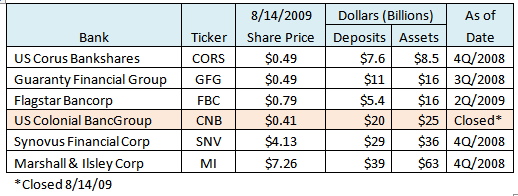
Banks mentioned being in trouble by Bloomberg (here) include Wisconsin’s Marshall & Ilsley Corp. (MI), Georgia’s Synovus Financial Corp. (SNV), Michigan’s Flagstar Bancorp (FBC), Chicago-based Corus Bankshares Inc. (CORS), Austin-based Guaranty Financial Group Inc (GFG), and Colonial BancGroup Inc. (CNB) in Montgomery, Alabama.

These six banks became five at the close of business Friday, Aug. 14, as Colonial BancGroup was taken over by the State of Alabama and the FDIC. This was the largest bank failure since IndyMac Bank went under in the summer of 2008.

The following table shows some data regarding the six banks singled out by name in the Bloomberg article.

On July 5, Bill Cassill wrote (here) that he projected 125 bank failures for 2009 and 230 in 2010.

However, as of that date, Bill projected 82 closings by 9/30 and we have already reached 77 on 8/14. We still have half the quarter to go. With the 150 additional banks estimated by the Bloomberg article, and the 77 already closed thus far this year, we could be closer to 230 closings in 2009 than the 125 estimated just six weeks ago. Bill is not alone. I recall hearing other estimates of bank failures for 2009 of the order of 100 for the entire year.

The following graph (and the prediction below it) was provided on July 12 (here) by Colin Peterson.

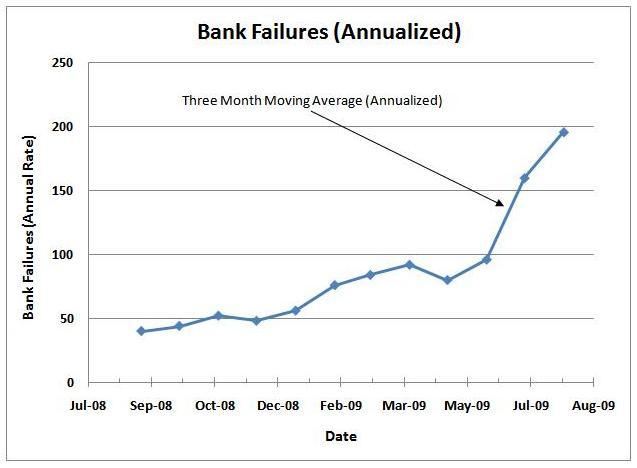
How is Colin's prediction doing? The following graph shows how bank failure rates have been trending.

Give Colin the handicapper award here. Not only have bank failure rates spiked, the current annualized rate would be in a virtual three-way tie for second highest in history if maintained for another nine months.

link.....

Read more...

Tuesday, August 4, 2009

Bank regulators dig in against Obama shake-up

Photo

Top U.S. bank regulators will speak out on Tuesday against some key elements of the Obama administration's plan to reshape financial regulation, saying parts of it were unneeded or could be disruptive.

The officials' defiance, in prepared congressional testimony obtained by Reuters, came despite a warning given to them on Friday by Treasury Secretary Timothy Geithner.

In private remarks punctuated with expletives, Geithner urged the regulators to end their turf battles and show support for President Barack Obama's plan, according to a person familiar with the situation on Monday.

But that seemed to have little impact on John Bowman, acting director of the Office of Thrift Supervision (OTS), an agency slated for closure under the Obama plan.

"We do not support the administration's proposal to establish a new agency, the National Bank Supervisor (NBS), by eliminating the Office of the Comptroller of the Currency ... and the OTS," Bowman said in written remarks to be given to the Senate Banking Committee at a hearing.

In addition, he said, "The OTS does not support the provision in the administration's proposal to eliminate the thrift charter and require all federal thrift institutions to change their charter."

Such words marked a retrenching of regulators' opposition to portions of Obama's plans to tighten oversight of banks and capital markets amid the worst financial crisis in generations and with the economy mired in a stubborn recession.

"We do not see merit or wisdom in consolidating federal supervision of national and state banking charters into a single regulator," FDIC chairman Sheila Bair said in her remarks ahead of the hearing on regulatory reform. link....

Read more...

Monday, August 3, 2009

Barclays Capital to Hire as Many as 1,000 Workers, Diamond Says

Barclays Plc, the U.K.’s second- biggest lender, plans to hire as many as 1,000 people, including investment bankers at its Barclays Capital unit, by the end of the year to compete in mergers advice and share sales.

“It would be tilted towards Asia. We need another six to twelve months to complete the build-out,” Barclays President Bob Diamond, 58, said today in an interview. “Equities, advisory and emerging markets would be the areas.”

Earnings at Barclays Capital rose to 1.05 billion pounds ($1.76 billion), from 524 million pounds in the first six months of the year, London-based Barclays said today. The securities unit was helped by thawing credit markets after the company’s September purchase of Lehman Brothers Holdings Inc.’s North American unit, formerly the biggest U.S. bond trader.

“The Lehman acquisition was clearly a strong, strategic move,” Diamond said. “We are getting the benefits already,” he said, adding that it’s unlikely Barclays would expand further into investment banking through acquisitions.

The new hires will leave Barclays Capital’s headcount about the same as it was at the end of 2008. Barclays Capital hired about 2,000 people in the six months on the year, after trimming numbers by 3,000.

Barclays, founded in 1736 as a goldsmithing and banking company, is returning to a business it abandoned 12 years ago when it sold Barclays de Zoete Wedd’s money-losing European equity and corporate finance unit to Credit Suisse Group in 1997 to focus on bonds and loans. At the time, London-based Barclays said expanding BZW’s mostly U.K.-focused units globally would require more capital than it could justify.

“BZW was a marginally profitable U.K. institution,” Diamond said. “Lehman was a premiere firm in the biggest market -- the U.S.”

Expanding in Europe

Barclays Capital has been hiring M&A bankers from Citigroup Inc. and Morgan Stanley in London to expand its European advisory business. The firm named Morgan Stanley’s Mark Warham and Citigroup’s Matthew Ponsonby co-heads of European M&A in May.

“Barclays has approached the task of building up its investment banking business much more aggressively” than Nomura Holdings Inc., which bought some of Lehman’s assets in Europe, Roy Smith, a finance professor at New York University’s Stern School of Business and a former Goldman Sachs Group Inc. partner, said July 24.

“Diamond is clearly pursuing the capturing of market share from a shaken up industry, and is starting from a substantial position in the global credit markets.”

Barclays Capital is ranked sixth in global takeovers this year, advising on deals valued at about $130.3 billion, according to data compiled by Bloomberg. That includes the firm’s agreement to sell its iShares exchange-traded funds business to CVC Capital Partners Ltd. for $4.37 billion.

The bank also maintained its position as the world’s biggest underwriter of international bond sales, beating New York-based JPMorgan Chase & Co. and HSBC Holdings Plc, Bloomberg data show. link.....

Read more...

Wednesday, July 29, 2009

ArcelorMittal posts $0.8 bn loss in Q2

ArcelorMittal logoArcelorMittal reported on Wednesday a net loss of 0.8 billion for the second quarter of this year due to heavy inventory write-downs and workforce reduction programmes.

"The loss in the second quarter of 2009 resulted from exceptional charges amounting to $1.2 billion primarily related to write-downs of inventory ($0.9 billion) and provisions for workforce reductions ($0.3 billion)," L N Mittal-promoted company said.

The company had a profit of $5.8 billion in the same quarter of the last fiscal.

ArcelorMittal saw its sales plunging by nearly 60 per cent to $15.2 billion in the reporting quarter compared to the period a year ago due to fall in steel demand and prices.

"The main reason for the decline continues to be the extreme weakness in demand for steel products in 2009 as a result of the global economic crisis, along with a steep fall in prices," it added.

However, the company is hopeful of a demand revival in the second half of the year and is mulling the rollback of 50 per cent production cuts at some of its facilities.

"In recent weeks, we have started to see some initial signs of recovery, as a result of which we are now planning to re-start production at some facilities. Provided there are no further unexpected economic deteriorations, we should see continued gradual improvement throughout the second half of the year," Mittal said.

link....

Read more...

Tuesday, July 28, 2009

CFTC report blames speculators for oil price swings

The U.S. Commodity Futures Trading Commission (CFTC) is planning to issue a report next month that suggests that wild swings in oil prices were significantly driven by speculators, the Wall Street Journal reported on its website on Tuesday.

A 2008 report by the main U.S. futures-market regulator that attributed oil-price swings primarily on supply and demand was based on "deeply flawed data," Bart Chilton, one of four CFTC commissioners, told the paper in an interview on Monday.

The CFTC did not reveal preliminary figures from the report to the paper and declined to discuss the previous data.

Reuters attempts to contact the agency outside regular U.S. business hours were unsuccessful.

The CFTC will hold the first of three hearings on Tuesday to consider whether to limit holdings of energy and agricultural contracts and whether some traders should be allowed to exceed so-called position limits. link....

Read more...

Friday, July 24, 2009

UPDATE 4-Ericsson starts to feel pinch of economic downturn

Ericsson (ERICb.ST), the world's biggest supplier of cellphone network equipment, said on Friday the economic downturn was now taking a bigger toll on its market, a shift that took the gloss off a sharp rise in its headline second-quarter profit and sent its shares lower.

The company had been largely unscathed by the economic woes, sheltered by robust sales in China and strength in its services business, while growing its share of a shrinking market for mobile network gear. [ID:nLL338473]

But Chief Executive Carl-Henric Svanberg said the effects of the financial crisis were now being seen, especially in emerging markets where currency wobbles were adding to economic woes.

"The weak economy that we have now will not go away for the next several quarters anyway, so we are living in a tougher environment," he told a news conference.

"I don't think we can give any better indications of whether it's going to be a little bit better or a little bit worse. It is an uncertain environment."

Chief Financial Officer Hans Vestberg, who will take the helm after Svanberg moves to BP (BP.L), also told analysts that operators were optimising cashflows, making it tough to collect.

Vodafone (VOD.L), the world's largest mobile phone company, said on Friday its earnings this year would be flat to lower [ID:nLN357408] while Nordic market leader TeliaSonera said it was focused on cutting costs. [ID:nLN330842]

Ericsson's second-quarter operating earnings rose 47 percent to 6.9 billion Swedish crowns ($914 million), excluding restructuring charges and its loss-making joint ventures, while sales were up 7.4 percent at 52.1 billion crowns.

Analysts had on average forecast a profit of 6 billion crowns and sales of 52.9 billion, according to a Reuters poll.

"It's a bit of a mix. On the negative side we have the cautious comments on the macro environment -- this will get noticed and should be seen as a warning sign for the later part of the year," West LB analyst Thomas Langer said. link....

Read more...

Monday, July 20, 2009

Legg Mason swings to a profit in "comeback quarter

Legg Mason Inc (LM.N), the tenth-largest U.S. asset manager, powered past market expectations on Monday with its first profit in six quarters, bolstered by cost savings and rising equity markets.

The results signaled a comeback, said Chief Executive Mark Fetting.

Shares of the company rose 6.3 percent in after-hours trading.

Jefferies & Co analyst Dan Fannon called the fiscal first quarter performance "a step in the right direction" though he noted the company still suffers from net outflows. "It's a turnaround story that continues to show progress," he said.

Net profit in the three months to June 30 was $50.1 million compared with a loss of $36.1 million a year earlier and despite a 42 percent slide in revenue to $613.1 million on a drop in fees. The industry generates the bulk of its revenue from fees based on a percentage of assets under management.

Fetting said the quarter was helped by reduced operating expenses, which fell to $554.8 million from $825.1 million a year earlier. Calling it "A comeback quarter feels right to me," he said in an interview with Reuters.

The company's best-known fund manager, famed stock-picker Bill Miller, has had a comeback much like his employers'. After a disastrous 2008, Miller's $4.2 billion Legg Mason Value Trust is up 18.16 percent for the year so far as of July 19, 12.5 percentage points better than its benchmark S&P 500 Index.

However, Miller still trails the benchmark and rivals over one, three and five-year periods after beating the benchmark for more than a decade.

The industry is in the midst of a consolidation period following rival BlackRock Inc's pending $13.5 billion deal to buy Barclays Group Investors, and Fetting said that deal "solidifies a strong global leadership for BlackRock and the rest of us have to pick up the pace."

Asked if that meant acquisitions for Legg Mason, Fetting said in the near term it is more likely to work with its existing affiliate managers "rather than an outright separate major transaction." He added Legg won't be buying Bank of America's Columbia Management unit, though he declined to elaborate.

Baltimore-based Legg Mason was among the asset managers hardest-hit by the economic downturn, and has been forced to spend heavily in order to prop up troubled assets in its money market funds, starting in the fall of 2007. In May the company also reduced its dividend sharply.

On a per-share basis, net income reached 35 cents in the quarter, up from a loss of 26 cents a year earlier and beating the average forecast of 22 cents a share expected by analysts surveyed by Reuters Estimates. Operating revenue was $613.1 million, just above the average of $612 million expected by analysts.

Legg had $22 billion in outflows from its fixed-income funds and $6 billion in equity outflows.

But assets under management rose 4 percent to $656.9 billion from $632.4 billion at the end of the previous quarter, driven by market appreciation of 9 percent, the company said.

Shares of Legg Mason rose 6.3 percent to $26.50 in extended trading from their $24.94 close in regular trade on the New York Stock Exchange. link....

Read more...

Sunday, July 19, 2009

Wal-Mart, despite recession, building SuperCenter

The construction of retail complex in Reno that will include a Wal-Mart store is giving the region's recession-pocked economy a boost.

Flood controls and walkways are being built along the Truckee River on the site owned by the Reno-Sparks Indian Colony.

Bentonville, Ark.-based Wal-Mart, the world's largest retailer, has benefited from the recession as shoppers scour for deals and focus on necessities. But University of Nevada economics professor Mark Pingle says the decision to move forward with a new SuperCenter store in Reno was gutsy.

Wal-Mart plans to close an older store and build a second new one in the Reno area.

Information from: Reno Gazette-Journal, http://www.rgj.com

Copyright 2009 The Associated Press. All rights reserved. This material may not be published, broadcast, rewritten or redistributed. link...

Read more...

Wall Street looks to earnings to extend rally

The Dow Jones industrial average is coming off its best week since March after reports from big companies like banker Goldman Sachs Group Inc., chip maker Intel Corp. and International Business Machines Corp. injected fresh hope in the market that the economy could be recovering.
The better-than-expected profits and forecasts pumped up the stodk market after a monthlong slide when investors detected few new signals that the economy was improving.
But analysts remain cautious and are hoping the good news won't fade.
"It probably gets tougher as we move further through the earnings season mainly because we get some sectors where the wind might not have been as much at their back," said Jeffrey Kleintop, chief market strategist at LPL Financial in Boston. He said retailers and smaller banks aren't likely to have fared as well as the companies that reported last week.
Corporate heavyweights reporting this week should sharpen investors' view of the economy. Reports on the April-June quarter are expected from American Express Co., aerospace manufacturer Boeing Co., industrial equipment maker Caterpillar Inc. and drug maker Merck & Co. Key consumer companies Amazon.com Inc., Apple Inc., Coca-Cola Co., eBay Inc., PepsiCo Inc. and Starbucks Corp. are also due to report.
Investors also will look to Capitol Hill for direction on the economy. Federal Reserve Chairman Ben Bernanke makes his semiannual report to Congress Tuesday and Wednesday. Investors want his take on the economy now, and also clues on how the central bank will eventually wean the economy from the emergency supports put in place last fall when the financial crisis intensified. The Fed has slashed interest rates, offered cheap loans to banks and purchased government debt to ratchet down borrowing costs.
Disappointment over what companies or Bernanke have to say could make the stock market stall again. The Standard & Poor's 500 index surged 40 percent from early March until mid-June when investors started asking whether an economic rebound was further off than they had projected. Last week's gains allowed the S&P 500 index to recover the 7 percent it had lost since the market's advance began to lose steam. link....

Read more...

Friday, July 17, 2009

Gold rises on oil rally but buyers remain cautious

Gold futures finished higher on Friday, helped by a crude oil rally, but bullion investors remained cautious absent definite signs of economic recovery and rising inflation.

"Until we can get a solid close above the $950 to $960 level, gold will be in broad trading range. I am looking for some further consolidation going into next week," said Ralph Preston, futures analyst at California-based HeritageWestFutures.com.

A brighter outlook for the financial sector amid economic optimism has underpinned the gold market this week. The metal, viewed as an inflation hedge, has been weighed down by the prospect of deflation, or a downward spiral in prices.

On Wednesday, gold scaled a two-week after rising toward $950 an ounce as a faster-than-expected pace of U.S. inflation sent Wall Street nearly 3 percent higher.

U.S. stocks traded slightly lower on Friday after a mixed bag of corporate earnings results.

U.S. August gold futures settled up $2.10 at $937.50 an ounce on the COMEX division of the New York Mercantile Exchange.

Spot gold traded at $938.20 an ounce at 3:37 p.m. EDT, against $936.35 in its previous session finish.

Bullion was initially pressured on Friday as the dollar index .DXY, which values the U.S. currency against six others, strengthened.

"Most bullion moves have been largely currency driven and the market is having to closely watch dollar index movement," said Richcomm Global Services senior analyst Pradeep Unni.

"Any uptick in the dollar index would clearly mean gold would have to give up its gains," he added.

Oil jumped nearly $2 toward the $64 a barrel mark after U.S. data showed the housing sector was starting to stabilize, boosting interest in the industrial commodities. Base metals prices also swung higher.

Firmer crude prices support interest in gold as a hedge against oil-led inflation, and signal firm demand for commodities as an asset class.

But demand for both investment gold and jewelry remained soft during the summer lull.

Holdings of the largest gold exchange-traded fund, the SPDR Gold Trust, inched up 0.31 tonnes on Thursday. However, London's ETF Securities said it saw an outflow of nearly 40,000 ounces that day from its ETFS Physical Gold (PHAU.L) product. link....

Read more...

Wednesday, July 15, 2009

Buying spree keeps KSE in green zone, 100-share index up 54 pts

KARACHI: Bullish sentiments dominated proceedings at Karachi stock market on support from intense buying activities and on anticipation of fall in t-bill yields up to 100bps.

Analysts said Wednesday KSE Board of Directors’ move for launch of deliverable future contracts next month taken positive by retail/institutional investors, which kept the market in the positive zone.

The Karachi Stock Exchange (KSE) 100-share index gained 54.49 points or 0.71 percent to close at 7,689.15 points as compared to 7,631.66 points of the previous trading session. The KSE 30-share index also gained 30.84 points and closed at 8,258.84 compared to 8,228.00 points of the previous session. The KMI 30 index also gained 8.62 points to close at 11,501.59 points as against 11,492.97 points.

The market turnover went up by 11.98 percent and traded 236.24 million shares as compared to previous session’s 210.96 million shares. The overall market capitalisation was up by 0.75 percent to close at Rs 2.263 trillion as compared with Rs 2.246 trillion. Out of total 321 companies, 198 closed in the positive zone, 106 in negative while 17 remained unchanged.

Hasnain Asghar Ali, analyst at Aziz Fida Husein and Co said although entire economy is likely to benefit from the declining trend in the local interest rates, the sectors having a direct link continued to perform, the show was led by cement stocks, as the sector led the turnover, while auto and fertiliser sector followed the pursuit.

Ahsan Mehanti, senior analyst at Shahzad Chamdia Sec said rise in international capital markets, renewed interest of foreign/local investors in oversold market in the result announcement session played a catalyst role in positive activity.

The KSE 100 index opened in green zone with a gain of 28.92 points and at the end of the day closed at 7686.15 with a gain of 54.49 points. Trading activity was better as compared to the last trading session as the ready market volume stands at 236.246 million as compared to last trading session 210.988 million. Future market volume however stands nil shares as compared to nil shares last trading session. Market capitalisation stands over Rs 2.263 trillion.

DGK Cement was the volume leader in the share market with 20.52 million shares as it closed at Rs 34.07 after opening at Rs 32.56 making a financial gain of Rs 1.51. Fauji Cement traded 17.93 million shares as it closed at Rs 7.91 after opening at Rs 7.48 gaining paisas 43. link....

Read more...

  ©Template by Dicas Blogger.